Planning and Triage in the Disaster Scenario
5. Mass Casualty Management and Medical Care
5.2. Transfer organization
The transfer organization includes those procedures implemented to ensure that victims of a mass casualty incident will be safely, quickly, and efficiently transferred by appropriate vehicles to a prepared healthcare facility.
Transfer is organized according to different principles such as strict control of the rate and destination of evacuation to avoid overwhelming the health-care facilities. One of the roles of on-scene mass casualty management is to stop spontaneous evacuation from by-standers of unstable victims or those minimally injured. This unmanaged transport is unsafe, endangers the lives of victims, circumvents field decontamination process, and disrupts the implementation of the mass casualty management system. Victims should not be removed from the advanced medical post to health-care facilities before:
- They are in the most stable condition possible.
- They are adequately equipped for the transfer.
- The receiving health-care facility is correctly informed and ready to receive the patient.
- The most appropriate vehicle and escort are available
Control of Victim Flow: The Noria Principle
Patient movement (whether by walking, by stretcher, or by vehicle) must be in a “oneway” direction and without any back-tracking. From the impact zone to the collecting point, from the collecting point to the advanced medical post entrance, and subsequently to areas of treatment, evacuation, and hospital care, the victims will be on a one-way “conveyor belt”, taken from the scene to sophisticated levels of care (Figure 8)
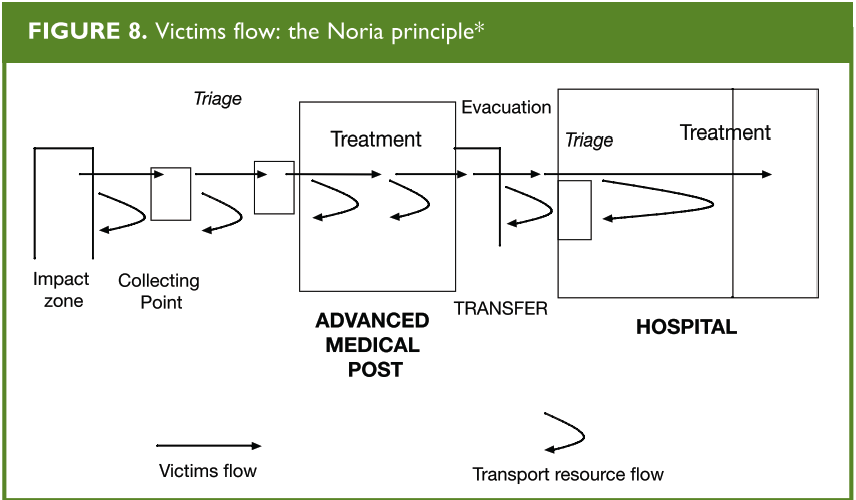
*This one-way progression from level to level by rotating transportation resources was labelled “Noria” in 1916 during the World War I battle of Chemin de Dames in Verdun, France. “Noria” comes from the Latin word for “wheel”. From: Establishing a Mass Casualty Management System, Washington D.C., 1996.