Disasters and their Effects on the Population
3. Definitions
Objectives
- Recognize events that can lead to disasters.
- Understand the individual and social factors associated with vulnerability, coping, and risk.
CASE
- You are informed there has been a flood affecting one of the provinces of your country. According to the latest population census, around 200,000 people who are mostly poor live in this area.
- What characteristics indicate that this event can be defined as a disaster?
- What type of disaster is it?
- Twenty-five percent of the population affected by the flood are children aged 0–12 years old. This population is more vulnerable than others in disaster situations.
- What characteristics make children more vulnerable?
- What specific interventions are necessary to diminish the effects of disaster upon children?
- After arriving at the flooded area, you must decide what to do to deliver health care to the victims.
- What is the first step to be taken?
- How useful are field hospitals in these situations?
- How would you estimate the need for external help?
What makes an event a disaster? Why is one hurricane or tornado a disaster and the next one, even with stronger winds, is just a bad storm? The answer lies with how the population is eventually affected: both the direct effects on the people as well as the indirect effects or damage to infrastructure. The United Nations International Strategy for Disaster Reduction defines disaster as a serious disruption of the functioning of a community or a society involving widespread human, material, economic or environmental losses and impacts, which exceeds the ability of the affected community or society to cope using its own resources.
Disasters are often described as a result of the combination of: exposure to a hazard; the conditions of vulnerability that are present; and insufficient capacity or measures to reduce or cope with the potential negative consequences. Disaster impacts may include loss of life, injury, disease and other negative effects on human physical, mental and social well-being, together with damage to property, destruction of assets, loss of services, social and economic disruption and environmental degradation.
A disaster disrupts the normal pattern of life, causing both physical and emotional suffering and an overwhelming sense of helplessness and hopelessness. The impact on the socioeconomic structure of a region and environment often requires outside assistance and intervention. Although there are many definitions for disaster, there are three common factors.
BOX 1. Definitions of a disaster
“A disaster is a crisis resulting from a failure in human interactions with the physical and social environment. Disaster situations outstrip the capacity of individuals and societies to cope with adversity”.
HDI, From Disaster Relief to Development, Studies on Development, No 1 (Geneva: Henry Dunant Institute, 1988), p. 170.
“A disaster is the convergence, at a given moment and in a given place, of two factors: risk and vulnerability”.
G. Wilches-Chaux, “La vulnerabilidad global,” in Herramientas para la crisis: Desastres, ecologismo y formación profesional (Popayan, Colombia: Servicio Nacional de Aprendizaje [SENA], Sept. 1989).
“A disaster has occurred when the destructive effects of natural or man-made forces overwhelm the ability of a given area or community to meet the demand for health care.”
Mothershead JL et al. Disaster Planning. Available at: http://www.emedicine.com/emerg/topic718.htm#section~definitions_and_terminology.
“A disaster can be defined as a serious disruption of the functioning of a society, causing widespread human, material or environmental losses which exceed the ability of the affected society to cope using only its own resources.”
Bryce, C.P. “Stress management in disasters”, Washington D.C, OPS, 2001.
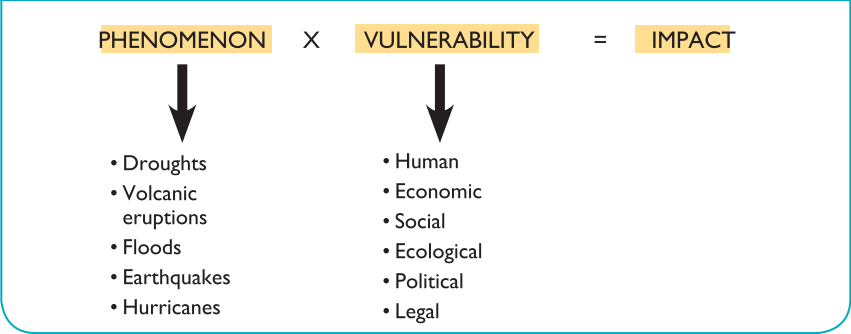
First, there is an event or phenomenon that impacts a population or an environment. Second, a vulnerable condition or characteristic allows the event to have a more serious impact.
For example, a hurricane will cause much greater damage to life and structures if it directly strikes an area with poorly constructed dwellings compared to striking a community of well-built homes with greater structural support. Identifying these factors has practical implications for communities’ preparedness and provides a basis for prevention.
Third, local resources are often inadequate to cope with the problems created by the phenomenon or event. Disasters affect communities in multiple ways. Their impact on the health care infrastructure is also multifactorial. The disaster event can cause an unexpected number of deaths. In addition, the large numbers of wounded and sick often exceed the local community’s health care delivery capacity.
The community’s capacity to care for those affected is often reduced because professionals, clinics and hospitals have been affected or destroyed. This will have long-term consequences leading to increased morbidity and mortality. An example of this can be seen in the 2010 Haiti earthquake disaster.
Prior to the January 12, 2010 earthquake in Haiti there were only 11 hospitals in Port-au-Prince. The earthquake damaged or destroyed at least eight of these hospitals. The remaining health facilities were quickly overwhelmed by large numbers of survivors requiring a wide range of care, particularly for traumatic injuries.
The Haiti earthquake demonstrates how a disaster becomes much more devastating when the preexisting medical system is already inadequate and poorly functional. This makes integrating and organizing outside assistance more fragmented and chaotic.
An epidemic or pandemic can cause a surge in the number of people seeking medical care and thus overwhelm the abilities of even a well-established medical system. The Ebola epidemic in West Africa is an example of how a disaster can affect the rest of the world.
Disasters can also have adverse effects on the environment that increase the risk for infectious diseases and environmental hazards. The loss of clean drinking water and proper sewage treatment can have devastating effects on affected populations. Food shortages can lead to severe nutritional consequences.
All these conditions may create a sense of hopelessness, vulnerability and an inability to envision a better future. People may stop planning their future such as finishing school, getting married or working. This “foreshortened future” affects the psychological and social behavior of the community. (Figure 1)
Figure 1. Components of a disaster
Adapted from Handbook of War and Public Health; ICRC; 1996.